
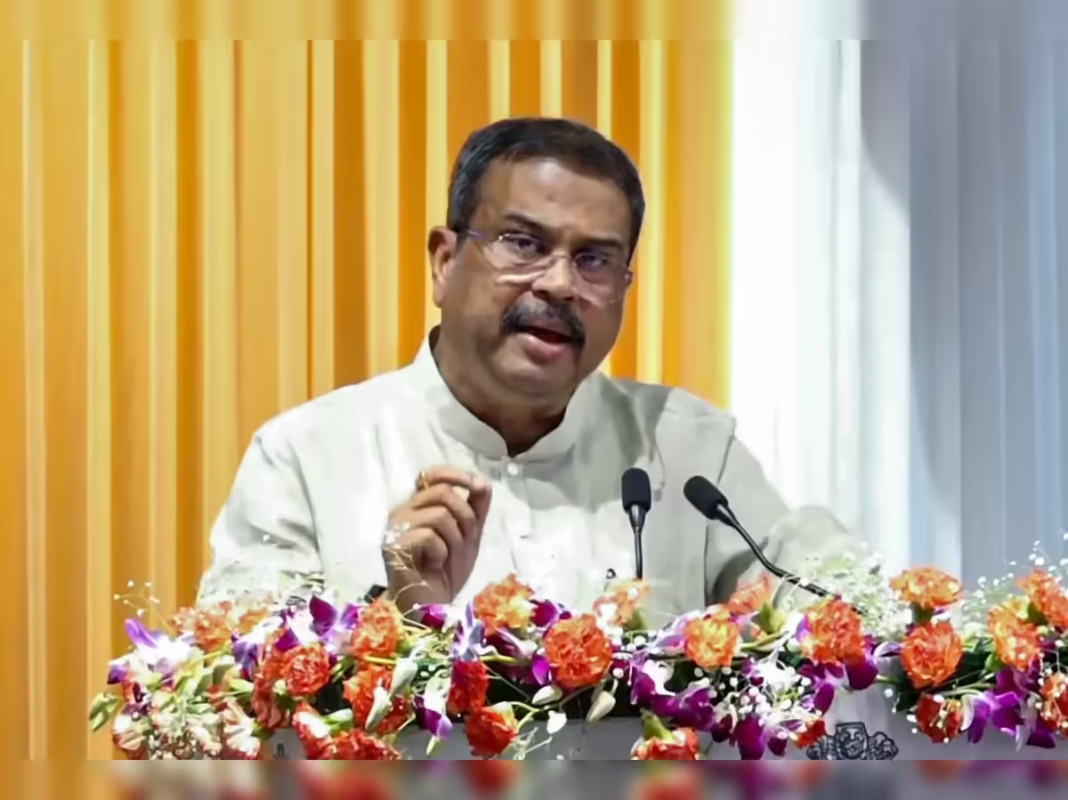
The political architecture of New Delhi experienced an unprecedented seismic shift as Dharmendra Pradhan Resigns as Education Minister, submitting his official letter to Prime Minister Narendra Modi. What began as scattered student grievances over examination irregularities quickly transformed into a nationwide youth movement that ultimately compelled one of the ruling administration’s most prominent cabinet figures to step down.
This exit represents a watershed moment in contemporary Indian political history. For weeks, student organizations, youth movements, and civil society groups rallied across the country, culminating in intense sit-ins at Jantar Mantar and widespread demonstrations near Parliament. With parliamentary proceedings threatening to grind to a complete halt and public pressure reaching an all-time high, the news that Dharmendra Pradhan Resigns as Education Minister became the ultimate symbol of institutional accountability and student-led democracy.
Anatomy of the Crisis: The NEET-UG Leak and the 48-Hour Tipping Point
The roots of this political storm lie in the execution and subsequent fallout of the NEET-UG competitive examination. Millions of young medical aspirants across India invest years of grueling preparation into this single exam, viewing it as their sole gateway to higher education and professional security. When widespread allegations of paper leaks and administrative compromises surfaced following the May examination, the psychological impact on the nation’s youth was instantaneous and profound.
Although the government initially attempted to manage the situation by transferring the investigation to the Central Bureau of Investigation and scheduling re-examinations, public anger continued to simmer beneath the surface. For many aspirants and their families, procedural delays and administrative reassurances were no longer enough to heal the loss of trust in the national testing apparatus.
The situation reached a critical breaking point during a tense forty-eight-hour window when student leaders and youth coalitions organized massive rallies across Delhi, Prayagraj, Kota, and Bengaluru. The protests, spearheaded in large part by student representatives and independent youth activists, coalesced around a singular, non-negotiable demand: the immediate resignation of the Union Education Minister as a demonstration of moral accountability.
When marches in the capital met heavy security cordons and police action, social media feeds were flooded with real-time footage of student-led demonstrations. The visual of thousands of young citizens demanding basic fairness in competitive testing created an overwhelming political swell that could no longer be contained within legislative committee rooms or press releases.
The Siege at Jantar Mantar and the Parliamentary Deadlock
As news of the student mobilizations spread, Jantar Mantar in central Delhi became the physical epicenter of the movement. Hunger strikes, public speeches, and continuous sit-ins drew thousands of supporters, creating an environment reminiscent of historical civil rights movements in India. Activists and youth leaders made it clear that no compromise or partial reform package would be accepted without executive accountability at the top.
Inside Parliament, the opposition seized upon the momentum generated on the streets. Continuous disruptions, adjournment notices, and fierce debates effectively paralyzed legislative proceedings. Opposition leaders argued that continuing normal parliamentary business while millions of students protested outside would be a direct betrayal of the nation’s youth.
With the threat of a complete parliamentary washout during a crucial legislative session, top government leadership engaged in emergency consultations. Security assessments, digital media monitoring, and political risk evaluations indicated that the protest movement was gaining broader sympathy among the general public. Recognizing that public order, institutional credibility, and the parliamentary agenda were all at risk, the decision was finalized: Dharmendra Pradhan would step down to defuse the escalating crisis.
Inside the Resignation Letter: What Was Said
In his formal letter addressed to Prime Minister Narendra Modi, Dharmendra Pradhan framed his departure not as an admission of personal guilt, but as an act of responsibility aimed at restoring calm and preserving national unity.
He emphasized his four-decade-long association with student movements and educational causes, asserting that the welfare of the country’s youth had always been his guiding principle. Acknowledging the deep pain felt by aspirants over the examination controversy, he insisted that his administration had worked tirelessly behind the scenes to protect the interests of genuine, hardworking candidates.
However, Pradhan noted with sadness that the intense political atmosphere surrounding the protests risked entangling the future of young students in prolonged legal and political battles. He expressed concern that external elements might attempt to exploit the emotional vulnerability of the youth to create broader instability.
By tendering his resignation, he stated that he wished to remove himself as a lightning rod for controversy, thereby allowing the government to focus entirely on administrative fixes, judicial reviews, and the smooth execution of upcoming academic schedules. Shortly after the President accepted the resignation, additional charge of the Ministry of Education was temporarily assigned to Union Cabinet Minister Pralhad Joshi.
My Opinion: Beyond Individual Resignations – A Systemic Reckoning
As an observer who has closely tracked the evolution of India’s education policy and youth movements, I view this resignation as a momentous, double-edged turning point. On one hand, seeing a senior minister step down in response to peaceful, youth-led street protests is a powerful validation of democratic accountability. For far too long, the immense mental agony suffered by students facing paper leaks, sudden exam cancellations, and endless litigation was treated by the political establishment as collateral damage. The fact that Gen-Z students forced the political leadership to sit up, listen, and offer a major sacrifice proves that public pressure can still bend the wheels of power in this country.
However, we must be careful not to mistake a political concession for systemic cure. Changing the face at the top of the Ministry of Education is a symbolic victory, but a person stepping down does not automatically fix a broken testing infrastructure. The real villain in this story is not just one politician; it is an over-centralized, hyper-pressurized, and vulnerable examination machinery that treats millions of young lives like entries on a spreadsheet.
In my view, India’s competitive examination culture has reached a point of severe toxicity. When a single three-hour test dictates the next forty years of a person’s life, the economic incentives for an examination mafia to breach security are practically irresistible. We have created a hyper-competitive pressure cooker where students face unbearable anxiety, coaching institutes print thousands of crores, and state testing agencies struggle with logistics and security gaps.
Replacing Dharmendra Pradhan with another minister will accomplish very little if the government simply returns to business as usual next month. What we need right now is a complete dismantling of single-window mega-examinations that concentrate too much risk into a single morning. We need decentralized testing frameworks, multi-stage evaluations, stringent computer-based security protocols, and strict, fast-tracked legal punishment for those who profit from paper leaks.
The students who sat in the heat at Jantar Mantar were not just asking for a minister’s head; they were begging for a fair shot at life. If the government treats this resignation merely as a public relations fire-extinguisher to clear the streets, they will miss the vital lesson of this movement. The real tribute to these young protesters will be a genuine, transparent overhaul of our entire education system so that no student ever feels that their hard work can be stolen away by a leaked PDF.
The Institutional Aftermath: Rebuilding Trust in National Examinations
In the wake of the resignation, the immediate challenge facing the government is operational survival. The Ministry of Education must now reassure millions of anxious families that upcoming entrance tests, university admissions, and recruitment drives will proceed without technical or moral flaws.
The central cabinet is already moving forward with emergency measures aimed at structural reform. Top on the legislative agenda is the proposed introduction of a rigorous national anti-paper-leak bill. This law aims to establish specialized Fast-Track Courts and dedicated Special Task Forces specifically equipped to investigate and prosecute examination fraud with severe, non-bailable penalties.
Simultaneously, discussions are underway to transition major paper-and-pen competitive tests completely into high-security Computer-Based Test formats starting next academic cycle. Independent auditing committees, featuring technical experts from top technology institutes and retired judicial figures, are being envisioned to oversee data handling and test center security.
What Lies Ahead for India’s Youth Movement
The resignation of Dharmendra Pradhan will undoubtedly be remembered as a defining milestone for Gen-Z activism in India. It has demonstrated that when students unite across regional, linguistic, and political divides around the core principle of fairness, they possess the power to shape the national narrative.
Yet, the coming months will test the endurance and focus of this movement. Student organizations must transition from demanding political exits to actively monitoring policy implementation. As Parliament considers new testing laws and administrative appointments, the eyes of the nation’s youth will remain firmly fixed on the halls of power, ensuring that promises made during a crisis turn into lasting, institutional guarantees for generations to come.
Follow us on instagram to get daily updates – @thetejwas
Also see-