
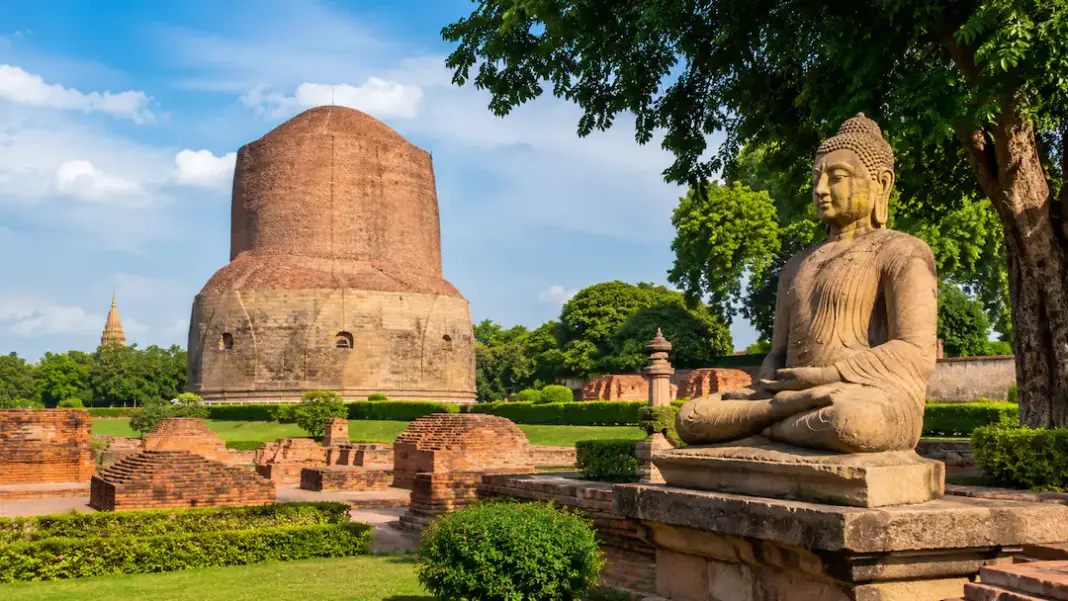
In a historic moment for global cultural preservation, the ancient Buddhist sanctuary of Sarnath has officially been inscribed on the prestigious UNESCO World Heritage List. The landmark announcement came during the 48th Session of the World Heritage Committee meeting in Busan, South Korea, crowning a twenty-eight-year administrative journey that began when the site was first placed on the tentative list in July 1998. With this recognition, Sarnath Named UNESCO World Heritage Site becomes India’s forty-fifth World Heritage Property and the fourth in Uttar Pradesh, expanding the state’s global heritage footprint beyond the Agra region into the heart of the eastern cultural corridor.
Located approximately ten kilometers from the ancient living city of Varanasi, Sarnath holds an irreplaceable sanctuary status in world history. It is the sacred landscape where Gautama Buddha delivered his foundational first sermon following his enlightenment at Bodh Gaya, setting in motion what classical Buddhist texts describe as the Dharmachakra Pravartana, or the Turning of the Wheel of Law. The UNESCO designation formally brings three of the four major Buddhist pilgrimage destinations—joining Lumbini in Nepal and Bodh Gaya in Bihar—under the highest level of international conservation protection.
A Twenty-Eight-Year Journey: From Tentative Listing to Global Glory
The path to achieving World Heritage status for Sarnath was both grueling and meticulous. When India submitted Sarnath to UNESCO’s tentative list on July 3, 1998, the site represented a complex conservation challenge. The property consists of two geographically distinct protected zones covering the Chaukhandi Stupa and the central Archaeological Remains of Sarnath, which encompass the towering Dhamek Stupa, the Dharmarajika Stupa, and the historic Deer Park.
Over the past two decades, Indian conservation authorities and independent heritage architects worked to construct a rigorous nomination dossier. The final nomination, titled Ancient Buddhist Site Sarnath, was officially submitted by the Union Ministry of Culture for the 2025–26 cycle, undergoing eighteen months of comprehensive technical evaluation by international experts from the International Council on Monuments and Sites.
Part of the preparatory work involved addressing historic narratives surrounding the discovery and maintenance of the site. In the months leading up to the nomination vote, the Archaeological Survey of India updated physical signage and documentation to properly credit local historical royal families alongside colonial-era archaeologists, reflecting a more accurate narrative of Sarnath’s preservation over the centuries.
Spiritual, Civilisational, and Architectural Significance of Sarnath
To understand why Sarnath holds exceptional universal value, one must look at the architectural and spiritual relics contained within its landscape. Following his enlightenment, the Buddha traveled across the Gangetic plains to find his five former companions at the deer park then known as Isipatana or Mrigadava. It was here that he articulated the Four Noble Truths and the Noble Eightfold Path, effectively founding the monastic order known as the Sangha.
Architecturally, the site preserves structures spanning from the third century BCE under Emperor Ashoka to the twelfth century CE under the Gahadavala dynasty. The most recognizable monument, the imposing Dhamek Stupa, stands over forty-two meters high and marks the precise location where the Buddha is believed to have taught his first disciples.
Nearby lies the base of the famous Ashokan Pillar. It was from this very pillar that archaeologists excavated the celebrated Lion Capital of Ashoka, depicting four Asiatic lions standing back-to-back atop a wheel of dharma. This masterpiece of ancient stone carving was adopted in 1950 as the official National Emblem of India, making Sarnath not only a spiritual sanctuary for global pilgrims but also the physical cradle of modern Indian state iconography.
National and Regional Impact: Elevating the UP Buddhist Circuit
The timing of the inscription brings transformative opportunities to the cultural and tourism landscape of Uttar Pradesh. Prior to this decision, the state’s existing World Heritage properties—the Taj Mahal, Agra Fort, and Fatehpur Sikri—were all heavily concentrated in western Uttar Pradesh. Sarnath’s inclusion expands this global footprint into the eastern sector, connecting Varanasi’s spiritual tourism directly with the broader regional Buddhist Circuit.
State tourism and cultural departments are preparing to leverage this milestone to attract longer-stay international visitors, particularly from East Asia, Southeast Asia, and global diaspora networks. Infrastructure initiatives, including sustainable electric mobility corridors connecting Varanasi Junction and Lal Bahadur Shastri International Airport to the Sarnath archaeological zone, are already being fast-tracked to manage the anticipated increase in pilgrim footfall.
Prime Minister Narendra Modi hailed the decision as a proud moment for every Indian, emphasizing that the teachings of Lord Buddha—rooted in peace, compassion, and universal harmony—continue to offer a timeless beacon for humanity. Union Culture Minister Gajendra Singh Shekhawat described the event as a defining recognition of India’s civilisational contributions to global thought.
Why Sarnath’s Inscription Is a Wake-Up Call for Heritage Management
As someone who closely follows cultural policy and national heritage developments, I view Sarnath’s inscription on the World Heritage List with a blend of immense pride and cautious realism. Getting a 2,500-year-old sanctuary recognized on the world’s most prestigious heritage platform after twenty-eight years is an undoubted triumph of diplomacy and conservation science. It validates the profound philosophical debt the world owes to Indian thought and provides a much-needed boost to Eastern Uttar Pradesh’s economic ecosystem.
However, we must confront an uncomfortable truth about what happens after the celebratory speeches end. A UNESCO badge is not merely a trophy to put on a promotional banner; it is a serious, binding commitment to protect a fragile archaeological landscape from being ruined by its own success.
Our record with managing high-density heritage sites in India has been mixed at best. Sarnath sits right on the urban fringe of Varanasi, one of the fastest-growing tourist hubs in the country. Anyone who has visited the Dhamek Stupa or Chaukhandi Stupa in recent years knows the pressures the surrounding buffer zone already faces—encroaching commercial vendors, unmanaged vehicular traffic, noise pollution, and inadequate visitor management during peak festival seasons.
If the government treats this inscription solely as a tool to drive up visitor volume, we risk damaging the very sanctity and physical fabric that made Sarnath world-famous in the first place. Sarnath is not an amusement park or a high-turnover tourist spot; it is a contemplative, sacred sanctuary meant for reflection and historical reverence.
What we need right now is a strict, ecologically sensitive management plan that enforces low-emission buffer zones, caps daily visitor intake near fragile stupa structures, and ensures that local communities around Sarnath directly benefit from tourism revenues rather than being displaced by commercial chains. UNESCO status should serve as a shield to protect Sarnath’s tranquil soul, not a green light for unchecked urban concrete around ancient ruins.
The Broader Context of India’s World Heritage Trajectory
India’s journey toward expanded World Heritage representation reflects a broader strategic push to showcase its civilisational history on the global stage. Over the past decade, the Ministry of Culture and the Archaeological Survey of India have systematically revamped nomination strategies, focusing on overlooked archaeological corridors, sacred geographies, and industrial heritage landmarks.
With forty-five inscribed properties, India now ranks among the top nations globally in terms of total World Heritage designations. This growing inventory brings increased international attention, but it also imposes significant financial and administrative responsibilities. Managing forty-five world-class heritage properties requires dedicated funding streams, specialized restoration personnel, and advanced digital monitoring tools to prevent structural decay and environmental degradation.
As Sarnath joins this elite network, it serves as a testing ground for how India balances modern infrastructure expansion with rigorous heritage conservation. The lessons learned from managing the urban-heritage interface in Varanasi will likely inform future nomination dossiers for other historic Indian sites currently waiting on the tentative list.
Urban Infrastructure vs. Heritage Preservation: Striking a Sustainable Balance
The challenge of preserving ancient sites in rapidly modernizing cities is one of the defining preservation issues of our time. Sarnath presents a unique case study in this global debate. The surrounding township has seen significant population growth, accompanied by commercial development, expanded road networks, and increased demand for modern amenities.
Conservation planners must establish a clear boundary between economic development and structural protection. This requires implementing smart zoning regulations that prevent high-rise construction within the sightlines of the Dhamek Stupa, creating dedicated pedestrian-only heritage zones, and utilizing non-invasive archaeological surveying technologies to identify buried structures before any new construction is approved.
Furthermore, integrating local communities into the stewardship of Sarnath is crucial for long-term sustainability. When residents view heritage protection as a source of community pride and sustainable economic opportunity rather than a restrictive burden, they become the primary defenders against unauthorized development and site degradation.
Looking Ahead: The Global Legacy of Sarnath
As the news circulates across global newsrooms and international cultural forums, Sarnath stands ready to welcome a new era of global fellowship. By securing its rightful place on the UNESCO World Heritage List, this ancient site in Varanasi reaffirms that India’s greatest gift to human civilization remains its timeless philosophy of peace, intellectual inquiry, and spiritual enlightenment.
Preserving Sarnath for future generations is not merely a national obligation; it is a collective responsibility shared with the international community. As visitors from around the world travel to stand before the Dhamek Stupa, they will be reminded of a message delivered over two and a half millennia ago—a message of compassion and wisdom that continues to resonate across borders and centuries.
Follow us on instagram @thetejwas.
Also see-