
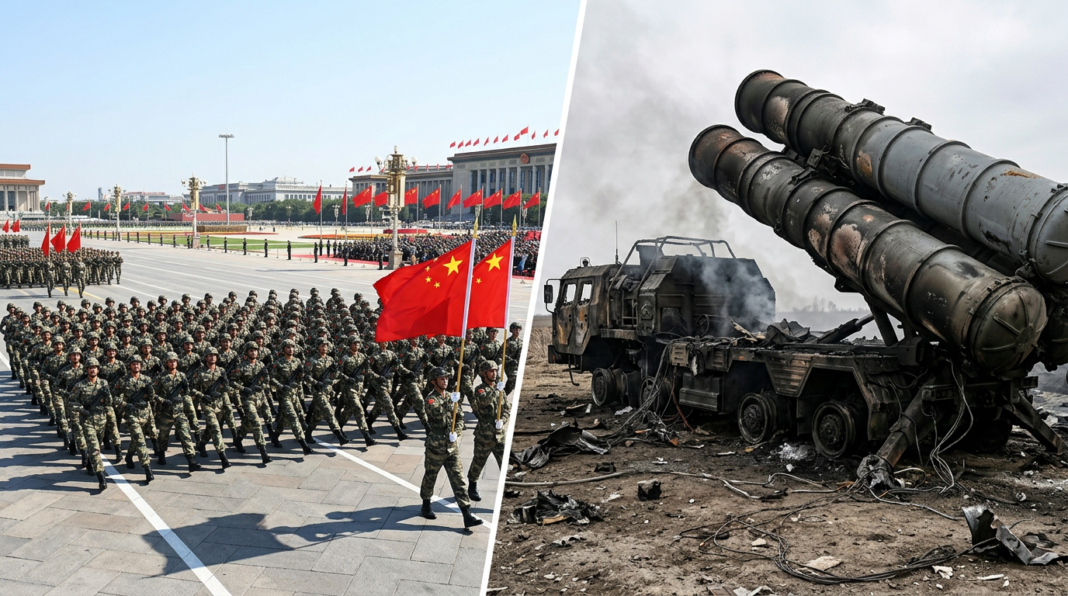
Three wars. Three continents. One humiliating pattern.
There is a principle every soldier knows:
You can fake the parade. You cannot fake the battlefield.
China has spent two decades building one of the most powerful military perceptions in modern history — fifth-generation stealth jets, hypersonic “carrier-killer” missiles, destroyer warships that rival any navy on earth. Beijing called them battle-ready. The world believed it.
Then the real wars started. And Chinese weapons began to fail — publicly, embarrassingly, and repeatedly.
Pakistan: The HQ-9 That Couldn’t Stop Anything
Pakistan is China’s most loyal arms customer. Roughly 82% of Pakistan’s defense imports come from China — a relationship Beijing proudly calls an “Iron Brotherhood.”
The crown jewel of that relationship was the HQ-9 Surface-to-Air Missile System — China’s answer to Russia’s S-400, priced at $3 million per unit, deployed to guard Pakistan’s most critical military sites.
During Operation Sindoor in May 2025, India launched precision strikes deep into Pakistani territory. The HQ-9 was supposed to stop them. It didn’t.
India’s BrahMos supersonic missiles hit their targets with ease. Indian loitering munitions destroyed multiple HQ-9 battery sites. Pakistan’s air defense network didn’t just fail — it was dismantled. Pakistan Air Force Vice Marshal Aurangzeb Ahmed publicly admitted the BrahMos’s trajectory made it “nearly impossible to intercept”.
Chinese analysts blamed Pakistani operators. But independent defense analysts pointed at the system itself — radar architecture borrowed from older Russian S-300 designs, with fundamental vulnerabilities to electronic warfare jamming. India exploited every one of them.
This wasn’t just Pakistan’s defeat. It was a credibility shock for every country that had bought, or was considering buying, Chinese defense technology.
Venezuela: The Blind Anti-Stealth Radar

January 3, 2026. US Special Operations forces launched a surprise raid on Caracas, capturing President Maduro. Before a single US aircraft crossed Venezuelan airspace, China’s marquee export radar system had already gone dark.
The JY-27A — sold to Venezuela by China Electronics Technology Group — was marketed as a stealth-defeating radar capable of detecting F-22s and F-35s from over 310 miles away. On paper, it was cutting-edge.
In reality, according to Newsweek and Global Defense Corp, the JY-27A was “devastatingly paralyzed” — likely suppressed by US electronic warfare before the main strike. Anti-radiation missiles finished the job. Venezuela’s entire air defense network went blind.
Social media called it “South America’s strongest air defense turned into scrap metal.”
There was another detail that quietly damned China even further: multiple JY-27A radar units in Venezuela had reportedly been non-operational for months before the attack — grounded by weak spare parts supply chains that Beijing had never adequately addressed.
Iran: When the Whole System Collapsed
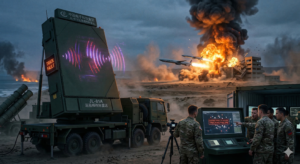
Iran’s air defense was considered among the most sophisticated in the Middle East — a multi-layered network combining Russian S-300 missiles with Chinese-origin radar and tracking systems.
During Operation Epic Fury in early 2026, those layers were penetrated anyway. Precision strikes reached their targets. And according to defense analysts tracking the conflict, Chinese-origin systems were failing to track incoming threats effectively — leaving deadly gaps at the worst possible moments.
The root cause? Chinese radars couldn’t communicate properly with non-Chinese missile systems. Iran’s hybrid defense network — mixing Chinese sensors with Russian launchers — suffered catastrophic integration failures. The network didn’t just struggle. It collapsed at the seams.
Why This Keeps Happening
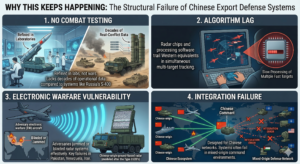
Three wars. Three failures. One structural pattern:
- No combat testing. Chinese systems are refined in laboratories, not wars. Russia’s S-400 has decades of real-conflict data. China’s exports don’t.
- Algorithm lag. Chinese radar chips and processing software trail behind Western equivalents in tracking multiple fast-moving targets simultaneously.
- Electronic warfare vulnerability. In all three cases — Pakistan, Venezuela, Iran — adversaries jammed or blinded Chinese radar systems before firing a single kinetic shot.
- Integration failure. Chinese systems work inside Chinese ecosystems. In mixed-origin defense networks, they break down.
SIPRI data already showed China’s arms exports had been declining before these battlefield disasters — falling 7.8% between 2016–2020. The failures of 2025–2026 will accelerate that slide.
A Fair Warning: Don’t Underestimate China
Balance requires honesty. China is building the world’s largest navy. It is advancing rapidly in hypersonic technology and AI-driven warfare. By 2035, Beijing has officially targeted becoming a “world-class military.”
What these battlefield failures expose is not that China has no military power — but that what it exports has been optimized for price, not performance. The weapons China sells to others are not the weapons China is building for itself.
The dragon is real. But some of what it sold to the world? That may genuinely be paper.
The Final Verdict
The term “Paper Tiger” was coined by Mao Zedong himself — used to mock imperialist powers that looked strong but crumbled under pressure. Today, the same phrase is being leveled at China’s defense exports by analysts worldwide. The irony is unmistakable.
Pakistan. Venezuela. Iran. Three continents. Three failures. One lesson:
In geopolitics, credibility is power. And on the battlefield, China’s credibility is bleeding out.
Follow Tejwas on Instagram, X, YouTube & Facebook — @thetejwas
Also See,
U.S. Military Plane Crash During Iran War: What Happened and Why It Matters
Saudi Oil Tanker Carrying 1 Million Barrels Highlights Strategic Energy Routes