
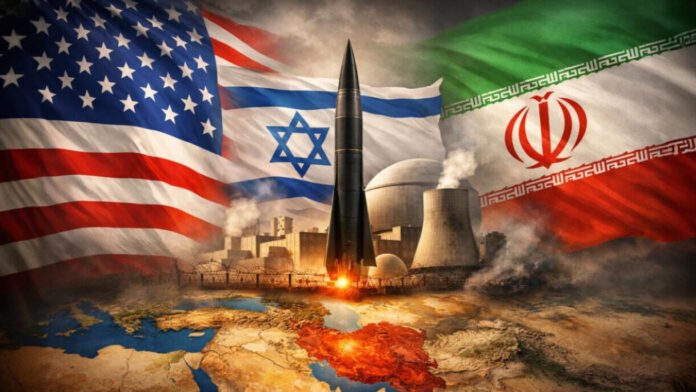
Strategic Context: Decades of Tension Lead to Military Action
Tensions between Iran, the United States, and Israel have been simmering for years over Tehran’s nuclear program, ballistic missiles, and regional influence. Despite periodic diplomatic engagements earlier in 2026 aimed at curbing Iran’s nuclear ambitions, talks failed to yield a breakthrough, leaving military options on the table for Washington and Jerusalem.Against this backdrop of distrust and strategic rivalry, an operation was launched on 28 February 2026, dramatically shifting the dynamics in the Middle East.
What Happened on 28 February 2026?
On Saturday, 28 February 2026, the United States and Israel launched a coordinated strike against multiple targets in Iran, including in Tehran and other cities such as Isfahan, Qom, Karaj, and Kermanshah.
1. Pre-Emptive Airstrikes and Battlespace
- Israel Defence Forces (IDF) announced a pre-emptive strike on Iran, describing it as necessary to eliminate imminent threats from Tehran’s military capabilities.
- The U.S. military simultaneously joined the operation, indicating major combat activity aimed at neutralizing Iranian missile systems and other strategic targets.
- Explosions and smoke were observed across Tehran, with sirens sounded and airspace closures declared by Iran, Israel, and neighboring countries including Iraq.
2. Closure of Airspace and Travel Disruptions
- Iran, Israel, and Iraq shut down their airspaces, prompting flight cancellations and reroutes by major airlines across the Middle East and beyond.
3. Iran’s Immediate Response
- Iran responded with missile and drone launches toward Israeli and U.S. positions in the region, preparing for broader retaliation.
- Tehran’s leadership, including Supreme Leader Ayatollah Ali Khamenei, was reportedly moved to a secure location as the crisis unfolded.
4. Political Messaging
- U.S. President Donald Trump and Israeli Prime Minister Benjamin Netanyahu framed the strikes as defensive—targeting threats from Iran’s nuclear and missile programs—with Trump urging Iranian citizens to rise against their government once possible.
Why This Matters: Regional & Global Impact
1. Escalation of a Long-Running Conflict
This joint military action marks one of the most significant escalations between Iran and Western allies in years—potentially rivaling or surpassing past confrontations. It reflects a shift from localized proxy battles to direct engagement on Iranian territory.
2. Risk of Wider War
With missile exchanges and airspace closures, the risk of a broader regional conflict involving Gulf states, U.S. bases, and allied forces has increased. This comes at a time when military mobilizations in the Middle East are among the largest seen since earlier decades.
3. Diplomatic Fallout
The strikes have dimmed hopes for peaceful diplomatic resolution over Iran’s nuclear ambitions, undermining negotiations and raising questions about the effectiveness of dialogue in averting military crises.
4. Civilian and Infrastructure Impacts
While detailed casualty figures are not yet confirmed, the strikes have caused extensive disruption and civilian panic, especially in major cities like Tehran—raising humanitarian concerns amid rising geopolitical tensions.
Long-Term Strategic Implications
The 2026 U.S.–Israel strikes on Iran may reshape power balances in the Middle East:
- Iran’s deterrence calculus may harden, pushing Tehran closer to non-Western allies.
- Global energy markets could face sustained instability.
- Defense postures of regional states (e.g., Gulf monarchies, Turkey) could significantly shift.
- Nuclear non-proliferation efforts are likely to be weakened if diplomacy is sidelined by military action.
Whether this marks a temporary flare-up or the beginning of a protracted conflict will depend on the coming weeks of diplomatic and military developments.
Follow our page @tejwas_ for daily updates on this unfolding story.
More from world;