

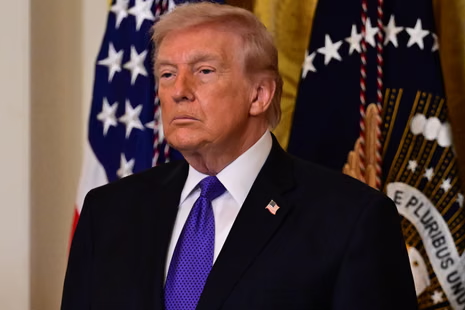
Trump Wants a Deal, Tehran Says No is the clearest way to describe America’s current approach to Iran. On one side, Donald Trump says there have been “productive” conversations and hints at a broader settlement. On the other, Iranian officials insist there have been no negotiations at all and have dismissed Trump’s claims as “fake news.” At the same time, Reuters reports that the United States is not stepping back from pressure altogether, because the five-day pause appears to apply only to attacks on Iran’s energy infrastructure, not to wider military options.
Trump Wants a Deal, Tehran Says No Signals a Two-Track U.S. Strategy
The contradiction is not accidental. Reuters reports that three senior Israeli officials believe Trump is determined to reach a deal with Iran aimed at ending hostilities, but they also doubt Iran will accept U.S. demands in any renewed negotiations. Those likely demands reportedly include limits on Iran’s nuclear and ballistic missile programs. At the same time, Washington appears unwilling to surrender military leverage while diplomacy remains uncertain.
This suggests that America is running a two-track strategy. The first track is diplomatic messaging: show the world that Washington is open to a settlement. The second is coercive signaling: keep enough military pressure in place so that Iran understands the cost of refusing U.S. terms. That is why the public message sounds like de-escalation, while the operational posture still looks like pressure.
Why Tehran Is Publicly Rejecting the U.S. Narrative
Iran’s denial also makes strategic sense. Reuters reports that Iranian officials rejected Trump’s claims of talks and said such claims were being used to manipulate financial and oil markets. From Tehran’s point of view, admitting talks while missiles are still flying and U.S. threats remain active could look like weakness at home and surrender abroad.
That is why Tehran is trying to control the narrative. By saying there are no talks, Iran protects its domestic image, avoids appearing pressured into diplomacy, and keeps the focus on U.S. inconsistency. In geopolitical crises, perception is often as important as policy. A state does not just fight over territory or deterrence; it also fights over who looks stronger, calmer, and less desperate.
America May Be Trying to Turn Military Gains into Diplomatic Leverage
Reuters reports that Israeli Prime Minister Benjamin Netanyahu said Trump sees an opportunity to use military gains made by Israel and the United States to push for an agreement that secures key strategic interests through diplomacy. That is an important clue. It suggests Washington may believe that battlefield pressure has created a window where Iran could eventually be forced toward a deal, even if it publicly denies that possibility today.
In other words, America may not be choosing between war and diplomacy. It may be trying to combine them. The logic would be simple: strike enough to weaken Iran’s position, pause selectively to calm markets and project reasonableness, and then invite a deal from a position of strength. Whether that works is another question entirely.
Markets Show Why America’s Messaging Matters
The global oil market is reacting to every signal. Reuters reports that crude dropped more than 10% after Trump announced a five-day suspension of attacks on Iranian infrastructure, only to rise again after Iran denied any talks. Reuters also reports that the Strait of Hormuz remains under severe strain, with around 20% of global oil and LNG flows affected by the disruption.
This matters because America’s words are now moving markets almost as much as military actions. A hint of diplomacy lowers panic. A denial from Tehran raises it again. That means Washington is not only communicating with Iran or Israel; it is also communicating with traders, allies, shipping firms, and governments watching for the next energy shock. In that sense, U.S. strategy is now partly economic theater as well as military statecraft.
So What Is America Really Doing?
Trump Wants a Deal, Tehran Says No points to a broader answer: America is trying to keep all options open at once. Reuters reports that the pause appears limited to energy-related targets, while other Iranian military and strategic assets remain exposed to possible U.S. action. That means Washington is not offering peace in the traditional sense. It is offering a narrow diplomatic opening while preserving escalation dominance.
This approach allows the U.S. to tell allies it is pursuing stability, tell markets it is not reckless, and tell adversaries it still holds the upper hand. But it also creates confusion. If diplomacy is real, why does pressure remain so intense? If military action is still active, why frame the moment as progress? That ambiguity may be intentional, but it also risks miscalculation.
Final Take
Trump Wants a Deal, Tehran Says No is not just a headline. It is the story of an American strategy built on contradiction. Washington appears to be mixing diplomacy, selective restraint, military leverage, and market signaling all at once. Reuters reporting suggests the U.S. wants a deal, but not at the cost of losing pressure; Iran wants to reject the appearance of talks, but not necessarily the benefits of time and space.
That is what America is really doing: trying to force a diplomatic outcome without giving up the tools of coercion. It may be smart strategy, or it may be a dangerous balancing act. Right now, it looks like both.
Follow us on instagram @thetejwas.
Also See-