
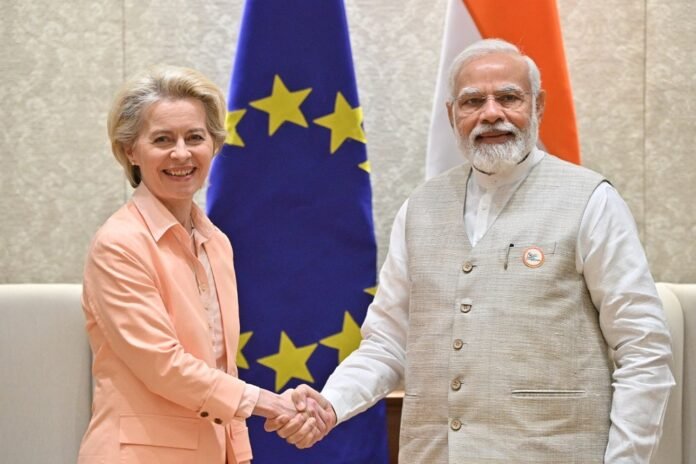
Strategic Context: Why India–European Union Relations Matter
In an era defined by supply chain disruptions, geopolitical fragmentation, and technological competition, India–European Union relations are gaining renewed strategic importance.
The European Union (EU), comprising 27 member states, represents one of the world’s largest economic blocs. For India, the EU is not just a trading partner — it is a crucial pillar in diversifying markets, accessing advanced technologies, and balancing global power structures amid intensifying US–China rivalry.
For Europe, India represents a stable democratic power, a fast-growing major economy, and a key Indo-Pacific partner capable of contributing to regional stability.
What Has Strengthened the Partnership?
1️⃣ Trade and Investment Momentum
The EU is among India’s largest trading partners. Negotiations for the long-pending India EU Free Trade Agreement (FTA) have regained momentum after years of stagnation.
Key focus areas include:
- Tariff reductions
- Digital trade standards
- Sustainable development clauses
- Investment protection mechanisms
If concluded, the FTA could significantly boost bilateral trade, currently crossing $120 billion annually.
2️⃣ Strategic and Geopolitical Convergence
Shared concerns over:China’s assertiveness,Maritime security in the Indo-Pacific,Energy security post-Ukraine war,have pushed India and the EU closer.
The Russia–Ukraine conflict reshaped Europe’s security calculus, while India’s role as a balancing power in Eurasia enhanced its diplomatic value to Brussels. Regular India-EU summits and ministerial dialogues reflect growing institutional engagement.
3️⃣ Technology and Green Transition

Cooperation is expanding in:Semiconductors,Clean energy,hydrogen,Digital governanceSupply chain resilience.
India’s renewable energy push aligns with Europe’s Green Deal ambitions. The partnership now includes joint working groups on emerging technologies and climate financing.
Why It Matters for India
1.Market Access Diversification – Reduces overdependence on the US and China.
2.Technology Transfer – Supports India’s manufacturing and digital ambitions.
3.Strategic Autonomy – Enhances India’s multi-alignment strategy.
4.Standards Setting Power – EU regulatory norms influence global trade architecture.
Risks and Frictions
Despite progress, challenges remain:
EU’s carbon border tax (CBAM) concerns for Indian exporters
Differences over human rights narrative
Agricultural and dairy market access disputes
Divergence on Russia policy
Balancing regulatory expectations with development priorities will be key.
Long-Term Implications:India–European Union relations are evolving from a trade-centric engagement to a comprehensive geopolitical partnership.As global power shifts from the Atlantic to the Indo-Pacific, the India-EU corridor could become central to shaping supply chains, climate governance, and digital norms.
For India, deepening ties with Europe strengthens its position as a pivotal power between East and West.
For Europe, India offers scale, stability, and strategic depth in Asia.
The coming years will determine whether this partnership matures into a defining axis of 21st-century geopolitics.
Follow our page @tejwas_ for daily updates.
Also see: