

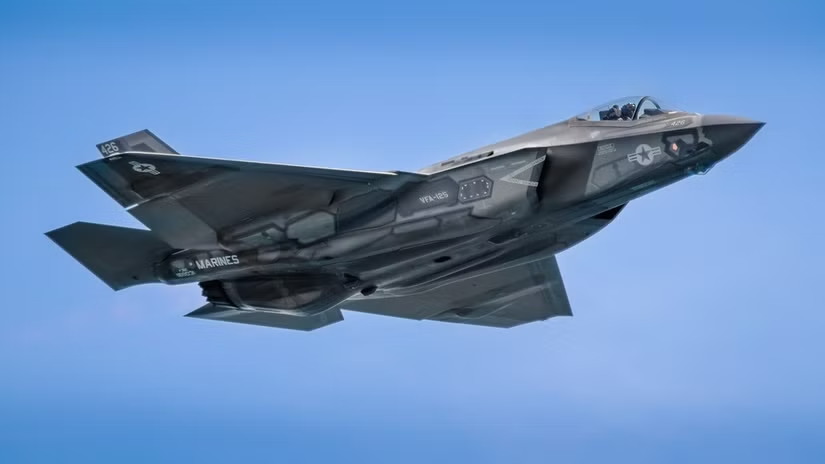
The Iran-Israel-US conflict narrative has taken a dramatic turn after claims emerged that Iran may have hit or challenged one of America’s most advanced military assets — the F-35 stealth fighter. Whether fully confirmed or not, such a claim is already making waves across geopolitical and defence circles. The reason is simple: the F-35 is not just another jet. It represents American technological superiority, stealth dominance, and battlefield deterrence.
If Iran has indeed managed to detect, track, damage, or even threaten an F-35 platform, it could have major implications for the perception of US military power in the Middle East. For TEJWAS readers, this is not just about one jet or one incident. It is about the changing nature of modern warfare, the rise of anti-stealth systems, and the message Tehran is trying to send to Washington and its allies.
Why the F-35 Matters So Much
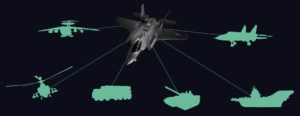
The F-35 is often seen as one of the most advanced fighter aircraft in the world. Built with stealth features, sensor fusion, and deep strike capability, it is designed to penetrate heavily defended airspace while avoiding detection. For the United States and its partners, the aircraft symbolizes next-generation air dominance.
That is why any claim involving an F-35 being hit immediately attracts global attention. Even an unverified report can become strategically significant because it challenges the perception that stealth aircraft can operate almost freely in hostile environments. In modern defence politics, perception matters nearly as much as battlefield reality.
Iran’s Strategic Messaging Behind the Claim
Iran understands the power of narrative in war. Even before any independent confirmation emerges, making such a claim helps Tehran in several ways. First, it boosts domestic morale by showing strength against a superior military opponent. Second, it sends a warning to regional adversaries that Iranian air defence systems may be more capable than expected. Third, it puts psychological pressure on the United States and its allies by questioning the invincibility of their most prized platforms.
In geopolitical terms, this is classic strategic messaging. Iran may be using the F-35 narrative not only to celebrate a possible battlefield moment but also to reshape how the conflict is being understood across the region.
Can Stealth Fighters Really Be Challenged?
The answer is yes — but not easily. Stealth does not mean invisible. It means harder to detect, track, and target. Modern air defence systems use a combination of radar bands, infrared tracking, electronic warfare, and layered missile networks to improve their chances against stealth aircraft.
Countries like Iran have long invested in indigenous defence capabilities, radar adaptation, and asymmetric strategies. Even if they cannot fully dominate the skies, they aim to raise the cost of enemy operations. If Iranian systems came close to an F-35 or forced tactical adjustments, that alone would be significant from a military analysis perspective.
What This Means for the US and Its Allies
For the United States, such a claim is damaging even before proof is established. If ignored, it allows Iran to dominate the information battlefield. If denied too aggressively, it can increase curiosity and suspicion. If proven even partially true, it could encourage rivals around the world to believe that American stealth advantage is narrowing.
For US allies, especially those depending on F-35 fleets, this would also raise questions about future air combat environments. It may lead to increased investment in electronic warfare, decoys, stand-off strikes, and unmanned support systems. In other words, even a single claim can influence future defence planning.
The Bigger Geopolitical Risk
This story is bigger than Iran and one aircraft. It reflects a broader shift in warfare where advanced military systems are increasingly challenged by adaptive, cheaper, and layered defences. The myth of complete technological invulnerability is fading.
If the Middle East becomes a proving ground where stealth platforms face rising threats, then future conflicts in Asia, Europe, and elsewhere will be studied through the same lens. Rivals like China and Russia will watch closely. So will countries buying American jets.
Conclusion
Iran’s claim about hitting or exposing an F-35 is not just a defence headline. It is a geopolitical signal. True or false, it is meant to challenge the image of US dominance and show that modern war is no longer defined by technology alone. Detection, disruption, perception, and propaganda now matter just as much.
For TEJWAS, the real takeaway is this: the battle is no longer only in the sky. It is also in the narrative. And in today’s geopolitical landscape, a claim can be almost as powerful as a confirmed strike.
Follow us on instagram @thetejwas .
Also see-