
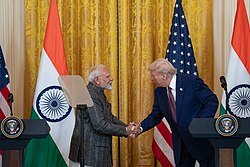
Strategic Context: From Estrangement to Alignment
Few bilateral relationships in modern geopolitics have evolved as dramatically as India–US relations
During the Cold War, New Delhi’s non-alignment and Washington’s alliance with Pakistan created strategic distance. Today, however, converging interests in the Indo-Pacific, supply chains, advanced technology, and balancing China have transformed the relationship into a defining pillar of 21st-century geopolitics.
The India–US partnership is no longer transactional — it is structural.
What Changed: Key Turning Points
1️⃣ Post-Cold War Reset
The collapse of the Soviet Union and India’s 1991 economic reforms opened space for re-engagement. Strategic dialogue slowly replaced suspicion.
2️⃣ The Civil Nuclear Breakthrough
The 2005–08 civil nuclear agreement under Manmohan Singh and George W. Bush marked a decisive shift. It effectively recognized India as a responsible nuclear power despite not being a signatory to the NPT.
This deal redefined trust and unlocked defense and technological cooperation.
3️⃣ The Indo-Pacific Convergence
The rise of China as a systemic competitor accelerated strategic convergence.
The revival of the Quadrilateral Security Dialogue (QUAD), alongside Japan and Australia, institutionalized maritime cooperation in the Indo-Pacific.
Defense Cooperation: From Buyer–Seller to Co-Development
Defense ties have become the backbone of India–US relations.
Key developments include:
Foundational agreements such as LEMOA, COMCASA, and BECA
Increasing joint military exercises like Exercise Malabar
India’s acquisition of US-origin platforms including Apache helicopters, P-8I maritime aircraft, and MH-60R helicopters.
The relationship is now moving toward co-production and co-development under initiatives like iCET (Initiative on Critical and Emerging Technology).
- This marks a shift from dependency to partnership.
- Technology, Supply Chains & Geoeconomics
- India–US relations are expanding beyond security into geoeconomic alignment
Key areas include:
- Semiconductor collaboration
- Critical minerals supply chains
- Defense industrial cooperation
- Space and AI collaboration
US companies increasingly view India as both a market and a strategic manufacturing partner amid efforts to diversify supply chains away from China.
For India, American technology and capital are essential for upgrading its industrial and innovation base.
Areas of Friction

Despite convergence, differences persist:
- Trade disputes and tariff issues
- India’s continued defense ties with Russia
- Divergences on human rights narratives
- Tactical differences in managing China
However, these frictions have not derailed the broader strategic trajectory.
Unlike alliance systems, India–US relations are built on alignment of interests rather than treaty obligations — allowing flexibility without formal entanglement.
Who Benefits?
- India: Gains advanced defense technology, diplomatic leverage, and strategic space against China.
- United States: Gains a capable democratic partner in the Indo-Pacific and a counterweight to Beijing.
- Indo-Pacific region: Benefits from a more balanced multipolar architecture.
Long-Term Implications
India–US relations are likely to deepen across three dimensions:
Maritime security in the Indo-Pacific
High-technology collaboration
Global governance reform (UNSC, multilateral institutions)
However, the partnership will remain non-alliance based. India will continue pursuing strategic autonomy, even as it aligns more closely with Washington on shared interests.
The defining feature of India–US relations is this: convergence without dependency.
As global power shifts intensify, this partnership will shape the balance of power in the Indo-Pacific and beyond.
Follow our page @tejwas_ for daily updates.
Also see: