

On the morning of April 3, 2026, Defence Minister Rajnath Singh posted a single line on X. In Hindi it read:
“Shabd nahi, Shakti hai — Aridhaman.”
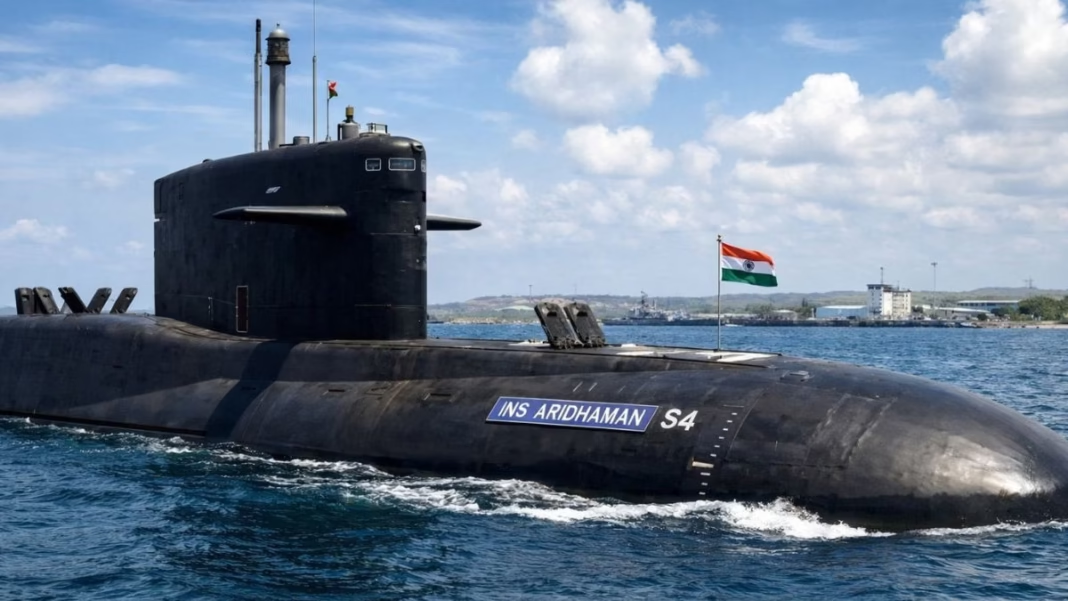
Translated: “It is not just a word, it is power — Aridhaman.” No press conference. No live broadcast. No fanfare. Just seven words and a name — and with that, India quietly crossed one of the most significant thresholds in its defence history. INS Aridhaman, the country’s third indigenously built nuclear-powered ballistic missile submarine, had been commissioned into the Indian Navy at a ceremony in Visakhapatnam, with Defence Minister Rajnath Singh and Chief of Naval Staff Admiral Dinesh Kumar Tripathi presiding.
The secrecy surrounding the event was deliberate. India’s SSBN — Ship Submersible Ballistic Nuclear — programme is among the most closely guarded defence projects the country runs. But what happened that morning in Visakhapatnam was not just a military milestone — the moment India Navy inducts third nuclear submarine INS Aridhaman, it was a structural shift in the balance of power in Asia.
What INS Aridhaman Actually Is ?
INS Aridhaman, whose name translates from Sanskrit as “Vanquisher of Foes,” is the third vessel of the Arihant class of nuclear-powered ballistic missile submarines, built under India’s classified Advanced Technology Vessel programme. It carries the designation S4 Strategic Strike Nuclear Submarine. The vessel was built at the Ship Building Centre in Visakhapatnam — fabricated by Larsen and Toubro — and underwent sea trials through 2022 to 2025, with reactor and weapons checks completed by mid-2025.
At approximately 7,000 tonnes, Aridhaman is slightly larger than its predecessors — INS Arihant, commissioned in 2016, and INS Arighaat, commissioned in August 2024. But size is not what makes it different. The critical leap forward lies in its weapons architecture and acoustic refinement.
Aridhaman carries eight vertical launch tubes — double the four tubes on INS Arihant. Each tube can house one K-4 intermediate-range ballistic missile with a reach of 3,500 kilometres, or the tube can be configured to carry three K-15 Sagarika short-range missiles with a 750-kilometre range, giving a total load of either eight K-4 missiles or 24 K-15 missiles. The K-4 missile — named after former President Dr. APJ Abdul Kalam — is a two-stage solid-fuel submarine-launched ballistic missile capable of cold launch from underwater. Its 3,500-kilometre range means a submarine sitting deep in the Bay of Bengal can hold targets across the entire region — and deep into mainland China — at risk, without ever approaching a monitored chokepoint.
Aridhaman is powered by an upgraded 83 MW pressurised light-water reactor developed indigenously by the Bhabha Atomic Research Centre, enabling prolonged underwater patrols and submerged speeds up to 24 knots. Its hull has been stretched to approximately 130 metres, providing a more refined hydrodynamic profile. The result is a submarine that is not just more powerful than its predecessors — it is also India’s quietest indigenous boat ever put to sea. In the world of undersea warfare, silence is the only armour that matters.
Why Three Submarines Changes Everything
To understand what today means, you have to understand what India’s nuclear deterrence posture looked like before this morning.
India operates under a No First Use nuclear doctrine. This means India will not use nuclear weapons unless attacked with nuclear weapons first. The entire credibility of that pledge rests on one capability — the ability to absorb a nuclear first strike and still retaliate. That is what strategists call a second-strike capability. Land-based missiles can be targeted and destroyed. Aircraft can be shot down. But a nuclear submarine lurking deep underwater, location unknown, is almost impossible to eliminate. That is why a sea-based leg of the nuclear triad is not optional — it is the foundation on which a No First Use doctrine becomes credible and not just a statement of intent.
With two submarines — Arihant and Arighaat — India could not guarantee that one would always be on patrol. One submarine would be at sea while the other underwent maintenance, leaving no reserve. With three submarines, that changes completely. Now India can maintain one on continuous active patrol, one on transit or standby, and one in maintenance rotation. Analysts have long noted that credible continuous deterrence requires a minimum of three to four SSBNs. INS Aridhaman’s commissioning is the threshold moment that makes India’s deterrence posture genuinely continuous and genuinely credible.
India has joined the United States, Russia, China, France and the United Kingdom as the only countries in the world capable of maintaining a continuous at-sea nuclear deterrent. For a country that launched its first nuclear submarine programme from scratch in the 1980s with significant technical challenges, arriving here in 2026 is an extraordinary achievement in indigenous defence capability.
What It Means for China and Pakistan
The K-4 missile’s 3,500-kilometre range is not an accident of engineering. It is a deliberate strategic choice. A submarine armed with K-4 missiles operating in the Bay of Bengal can strike any target within 3,500 kilometres. That includes Beijing. That includes Shanghai. That includes every major Chinese strategic installation along the eastern seaboard — without the submarine ever needing to venture into the heavily monitored South China Sea or the Pacific.
China has steadily expanded its own SSBN fleet — the Jin-class Type 094 submarines carry the JL-2 and JL-3 missiles — and has been increasing naval activity in the Indian Ocean region in recent years. China also operates approximately 11 to 12 nuclear submarines compared to India’s three. The numbers gap is real. But the commissioning of Aridhaman proves that India has overcome the steep learning curve of nuclear shipbuilding and is no longer merely an aspirant — it is an operator.
For Pakistan, the calculus is different but equally significant. Pakistan’s arms control adviser Zahir Kazmi has previously stated that India’s sea-based triad development puts the Indian Ocean region at risk of an arms race. What Aridhaman does is fundamentally alter Pakistan’s strategic thinking. Before, Pakistan could contemplate a scenario in which a pre-emptive strike might degrade India’s nuclear response capability. With a continuously patrolling SSBN carrying 3,500-kilometre range missiles, that calculus becomes a guarantee of national suicide. The deterrence is now real in a way it could only be theoretical before.
Made in India — And That Matters as Much as the Missile
The design is reportedly approximately 70 per cent indigenous. The reactor is built by BARC. The hull was fabricated by L&T. The sonar systems — the advanced Integrated Submarine Sonar System USHUS and Panchendriya suite with twin flank-array hydrophones — are indigenous. The missiles are DRDO-developed. The Ship Building Centre in Visakhapatnam, which began as a classified facility in the 1980s with Russian technical assistance, has now produced three operational nuclear submarines entirely on Indian soil.
Speaking at the commissioning of INS Taragiri the same day — the indigenously built advanced stealth frigate commissioned alongside Aridhaman’s induction — Rajnath Singh said that as India aims to become a developed nation by 2047, strengthening maritime power will play a key role in achieving that goal.
India’s nuclear submarine journey began with INS Arihant, launched in July 2009 after decades of development, and quietly commissioned in 2016. At that point, India’s sea-based deterrent was more symbolic than operational — Arihant carried only K-15 missiles with a 750-kilometre range, primarily sufficient to threaten Pakistan. Arighaat changed that slightly with K-4 integration. Aridhaman consolidates it. And the S5-class submarines already in planning — displacing nearly 17,000 tonnes with 12 to 16 K-5 and K-6 MIRV-capable missiles and a 190 MW reactor — will complete the transformation from regional power to global-reach nuclear deterrent.
What Comes Next
A fourth Arihant-class submarine is currently undergoing sea trials and is expected to join the fleet next year. The Indian Navy plans to commission its first fully indigenously designed nuclear attack submarine — an SSN rather than an SSBN — by 2036 to 2037. The Cabinet Committee on Security has already approved the first two SSNs. Until those arrive, India remains dependent on periodic leases of Russian Akula-class submarines, with Chakra III expected in approximately two years.
The full picture is one of a navy in transformation — moving from an ocean-going force into a genuine blue-water, nuclear-capable power with strategic reach across the entire Indo-Pacific. Every new submarine is not just a vessel. It is a message, transmitted silently from the deep, that India’s response to any nuclear threat will arrive regardless of what happens on the surface.
Tejwas Editorial
What happened at Visakhapatnam on April 3, 2026 will not trend the way a political speech trends. It will not break the internet. There was no live stream, no ticker, no press briefing. Seven words on X and the ceremony was done. That is precisely how nuclear deterrence is supposed to work — quietly, invisibly, and with absolute certainty. INS Aridhaman is not a trophy. It is a guarantee. It tells every adversary, whether they sit in Beijing or Rawalpindi, that India’s nuclear response capability can no longer be targeted, degraded or eliminated. The sea hides what no satellite can find. And what cannot be found cannot be destroyed. India has now crossed the threshold from nuclear state to continuously deterring nuclear state. That is not a semantic distinction. In the language of geopolitics, it is the difference between a threat and a promise. Aridhaman makes it a promise.
Follow us on instagram @thetejwas.
Also see-