
🧭 Strategic Context: Why This Matters
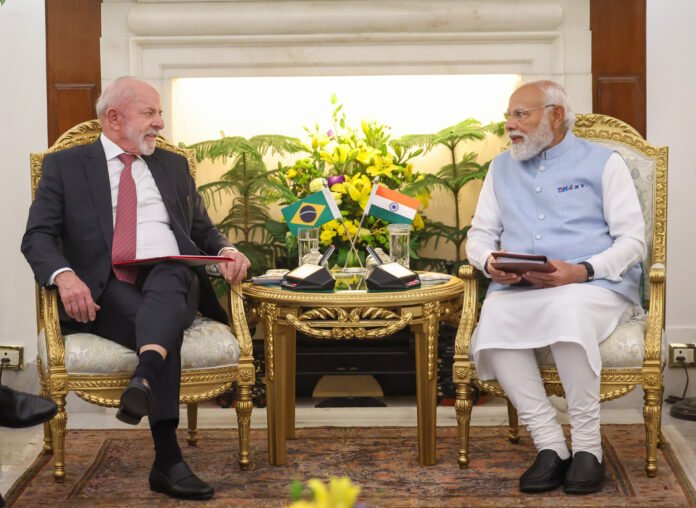
On 21 February 2026, India and Brazil agreed to substantially boost cooperation on rare earth elements and other critical minerals — a move with far-reaching implications for industrial supply chains, geopolitical competition, and the emerging multipolar economic order. The announcement came during Brazilian President Luiz Inácio Lula da Silva’s state visit to New Delhi and reflects both countries’ broader strategic priorities: securing essential inputs for technology and clean energy sectors while reducing over-dependence on existing dominant suppliers.
Rare earth elements — such as neodymium, praseodymium, and dysprosium — are indispensable for electric vehicles, renewable energy technologies, advanced electronics, and defence systems. Control over these resources and their processing capacity has become a geopolitical focal point of the 21st century.
🤝 What Happened: The Brazil-India Agreement
During the high-profile meeting in New Delhi, Prime Minister Narendra Modi and President Lula signed a non-binding Memorandum of Understanding (MoU) on critical minerals and rare earths. The pact lays the groundwork for cooperation in areas including:
- Reciprocal investment in mineral exploration and extraction projects.
- Joint ventures in mining and processing critical minerals.
- Collaboration on technology, including AI applications for mining efficiency and sustainability.
- Strengthening legal and institutional frameworks to support investment and research.
In his remarks, PM Modi described the deal as a “major step towards building resilient supply chains.” President Lula emphasized that expanding cooperation in renewable energy and critical minerals — central components of the agreement — will drive the next phase of bilateral ties.
🌍 Strategic Implications
-
Diversifying Supply Chains & Reducing China Dependence
China currently dominates global rare earth processing and much of the supply chain. This concentration poses economic and strategic vulnerabilities for many countries, including India, which imports a substantial share of these materials. The Brazil agreement is aimed at broadening sources and forging alternative supplier networks to mitigate this risk.
Brazil holds some of the world’s largest rare earth reserves — second only to a few nations — making it an attractive partner for long-term supply diversification.
-
Industrial, Technological, and Defence Gains
By collaborating with Brazil on extraction and processing, India seeks not just access to raw materials but the capability to integrate them into value-added supply chains — from manufacturing of components to advanced defence systems. Reducing reliance on a single dominant provider strengthens India’s industrial autonomy and bolsters its ambitions in sectors like clean energy, semiconductors, and aerospace.
-
Strengthening South-South Cooperation
This rare earth cooperation marks a shift toward deeper Global South partnerships in strategic sectors. Both Brazil and India have articulated visions of a world in which emerging economies play a larger role in steering global systems — in trade, technology, and governance. Their expanding partnership enhances mutual leverage and strategic agency vis-à-vis traditional powers.
🔮 Long-Term Outlook
The rare earths deal aligns with broader plans to elevate India-Brazil trade to beyond $20 billion in the next five years, with additional ambitions to scale even further. Beyond minerals, the state visit yielded MoUs across digital infrastructure, MSME cooperation, and clean energy technologies, signaling a multifaceted deepening of bilateral engagement.
If implemented effectively, this agreement could reshape Indo-Brazilian economic ties and contribute to a more resilient and diversified global critical minerals ecosystem — an outcome with implications for technology competition, climate goals, and sovereign supply chain security in the decades ahead.
Follow our page @tejwas_ for daily updates.
Also see: