
IRGC Sarollah HQ Tehran Damage Confirmed by Satellite Imagery
Strategic Context
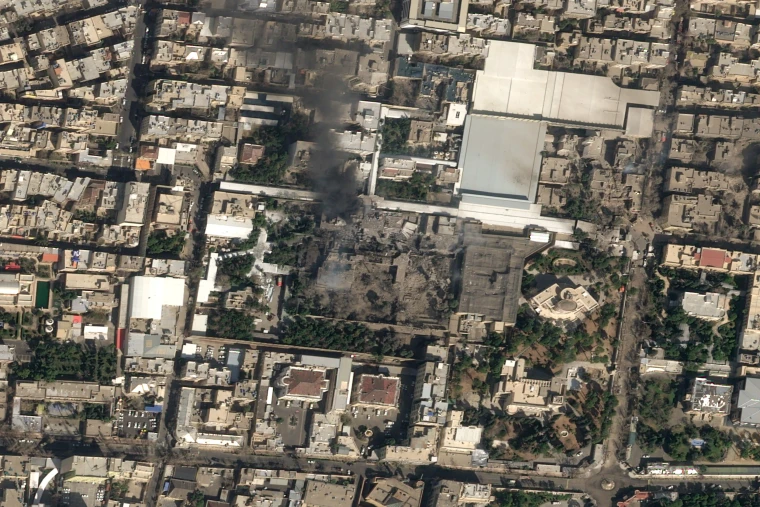
Satellite imagery has revealed significant structural damage at the Sarollah Headquarters of the Islamic Revolutionary Guard Corps (IRGC) in Tehran, marking one of the most consequential strikes on Iran’s military command infrastructure in the ongoing regional conflict.
The Sarollah HQ is a critical command center responsible for internal security operations and military coordination in the Iranian capital. Damage to this facility signals a direct attempt to degrade Iran’s command-and-control architecture during the escalating confrontation between Iran and the US–Israel coalition.The revelation comes amid a rapidly expanding conflict that has already seen missile strikes, drone attacks,
What the Satellite Images Show

High-resolution commercial satellite imagery taken after recent strikes shows extensive destruction across the IRGC headquarters compound in Tehran. Entire sections of buildings appear collapsed, while debris fields and scorched areas indicate direct precision impacts.
Before-and-after images reveal:
-
Multiple buildings within the IRGC command compound heavily damaged
-
Roof structures destroyed by precision-guided munitions
-
Rubble and debris scattered across the compound
-
Burn marks and smoke traces indicating large explosions
The images provide some of the clearest independent evidence of the intensity of the strikes on Tehran, with several government and security facilities affected across the capital.Other nearby strategic buildings—including government offices and intelligence facilities—also show visible structural damage in the imagery.
Why the Sarollah Headquarters Matters

The Sarollah Headquarters plays a central role in Iran’s security architecture. It oversees:
-
Security operations in Tehran
-
Coordination between the IRGC, Basij militia, and intelligence services
-
Crisis management and internal defense operations
-
Protection of key political institutions
As part of the broader IRGC command network, the Sarollah HQ functions as a strategic nerve center for regime security in the capital.Striking this facility sends a clear message: the campaign is targeting not just Iran’s military assets but also its command infrastructure and internal security apparatus.
Strategic Impact on the Iran Conflict
The strike on the IRGC headquarters is part of a wider campaign targeting Iran’s military infrastructure. Across the country, several missile bases, nuclear-related facilities, and command nodes have reportedly been hit in coordinated operations.
Analysts say these strikes aim to:
-
Reduce Iran’s ability to coordinate large-scale missile attacks
-
Disrupt command and communication systems
-
Limit the IRGC’s ability to manage internal security during wartime
The destruction at Sarollah HQ may complicate Iran’s ability to rapidly mobilize security forces in Tehran, particularly if unrest or crisis situations emerge during the conflict.
Long-Term Implications
The attack on the IRGC command center signals a shift toward high-value strategic targeting in the conflict. Instead of focusing only on missile launchers or military bases, the campaign appears designed to weaken the institutional backbone of Iran’s security establishment.If the trend continues, Iran could face growing challenges in maintaining centralized military coordination and internal control.
For regional stability, however, the risks remain significant. Tehran may respond by escalating strikes against US bases, Gulf infrastructure, or Israeli targets—potentially widening the conflict across the Middle East
Follow our page @tejwas_ for daily update
More from world;