

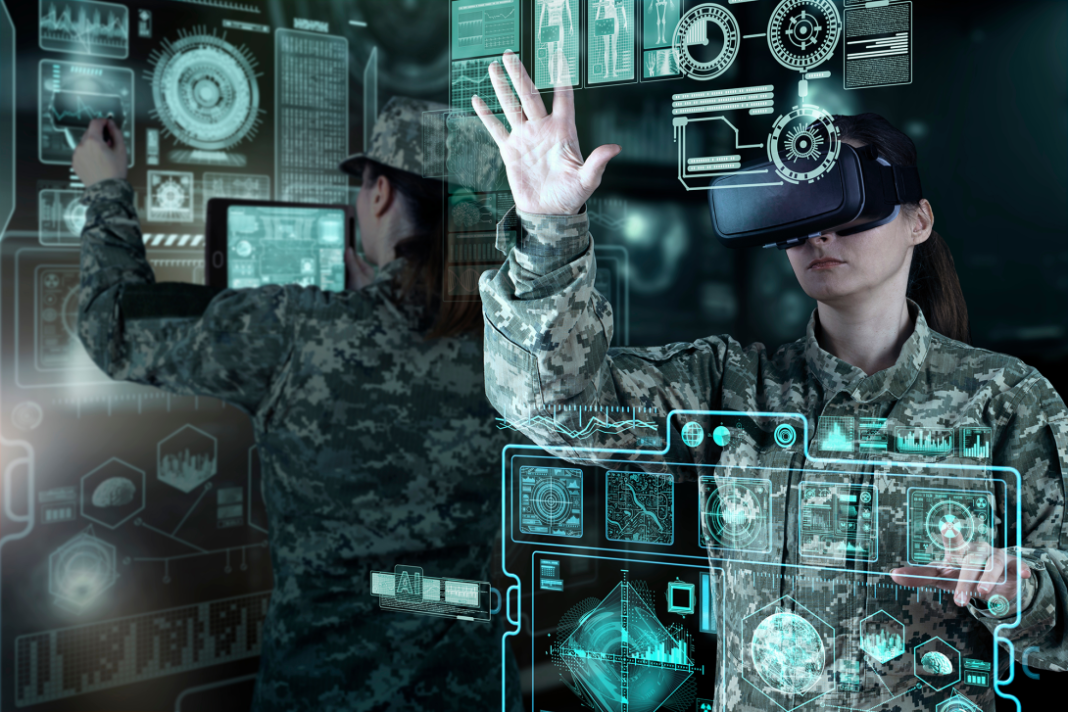
The character of warfare is changing faster than at any point since the Industrial Revolution.
Today, Defence and Technology are inseparable. Military superiority no longer depends solely on troop numbers or traditional firepower — it hinges on artificial intelligence, cyber capability, autonomous systems, space assets, and advanced electronics.
The Russia–Ukraine conflict, US–China competition, and rapid militarization of emerging technologies reveal a clear reality: technological advantage determines strategic leverage.
What Is Changing: The Technological Transformation of Warfare
1️⃣ Artificial Intelligence & Autonomous Systems
AI-driven systems are reshaping battlefield decision-making.
From drone swarms to predictive logistics and real-time intelligence analysis, AI compresses the “observe–orient–decide–act” loop. Nations like the United States and China are investing heavily in military AI to secure long-term dominance.
Autonomous underwater vehicles, loitering munitions, and unmanned combat aerial vehicles (UCAVs) are reducing risk to personnel while expanding operational reach.
2️⃣ Cyber and Information Warfare
The battlefield is no longer confined to land, air, and sea.
Cyber capabilities can disrupt power grids, communication systems, and financial networks without a single missile being fired. Offensive cyber tools now serve as instruments of strategic coercion.
Information warfare — including psychological operations and digital influence campaigns — has become a central pillar of hybrid conflict.
3️⃣ Space as a Warfighting Domain
Satellites underpin navigation, communication, and missile guidance. The weaponization of space is accelerating.
Meanwhile, anti-satellite (ASAT) tests by major powers underscore the vulnerability of orbital infrastructure.
Space dominance increasingly translates into terrestrial advantage.
4️⃣ Hypersonics & Advanced Missile Systems
Hypersonic glide vehicles capable of maneuvering at speeds above Mach 5 challenge existing missile defense systems.
Countries such as Russia and China have operationalized hypersonic platforms, pushing others to accelerate research and development.
These systems compress response times, complicate interception, and increase strategic instability if not managed carefully.
Why Defence and Technology Matter Strategically
Deterrence Is Becoming Technological
Military advantage increasingly depends on innovation cycles rather than stockpiles. The ability to integrate civilian technology into defense applications has become decisive.
Who Benefits?
- Technologically advanced militaries: Gain asymmetric advantage.
- Private defense innovators: Become central to national security ecosystems.
- Middle powers with tech ecosystems: Can punch above their weight if innovation aligns with strategy.
- For countries like India, integrating indigenous innovation with strategic doctrine is essential for credible deterrence and long-term autonomy.
Risks and Strategic Dilemmas
Arms Race Acceleration: Rapid tech adoption can destabilize deterrence.
Ethical Concerns: Autonomous lethal systems raise accountability issues.
Cyber Vulnerability: Highly digitized militaries face systemic exposure.
Technology Denial Regimes: Export controls may fragment global innovation networks.
Unchecked militarization of emerging technologies could intensify great-power rivalry.
Long-Term Implications
The fusion of defence and technology is reshaping global power hierarchies.
In the coming decades:
AI-enabled warfare will become mainstream.
Cyber deterrence doctrines will formalize.
Space security frameworks will gain urgency.
Public–private defense ecosystems will dominate strategic planning.
Ultimately, defence and technology will determine which states shape the international order — and which adapt to it.
In the 21st century, strategic power is no longer measured only in megatons or divisions — it is measured in microchips, code, and innovation capacity.
Follow our page @tejwas_ for daily updates.
Also see: