

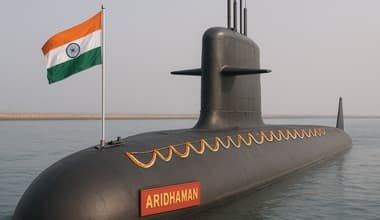
Strategic Context: India’s Quest for Credible Minimum Deterrence:-
For any major power operating in a contested geopolitical space, survivable nuclear capability remains the backbone of strategic autonomy. India’s nuclear doctrine emphasizes credible minimum deterrencdia’s second indigenous nuclear-powered ballistic missile submarine (SSBN), marks a significant milestone in operationalizing this survivable leg of the nuclear triad.
What Happened: India’s Second Arihant-Class SSBN:-
INS Aridhaman belongs to the Arihant-class submarine program — India’s first indigenous nuclear submarine project. It follows INS Arihant, which was commissioned in 2016 and conducted India’s first deterrence patrol in 2018.
Constructed at the Shipbuilding Centre in Visakhapatnam, the submarine was developed with key contributions from Defence Research and Development Organisation and operated by the Indian Navy.
Compared to INS Arihant, Aridhaman is reportedly larger and capable of carrying more advanced SLBMs such as the K-4, with a longer strike range than the earlier K-15 system. This enhances India’s ability to conduct deterrence patrols deeper in secure waters while retaining credible reach.
Why INS Aridhaman Matters
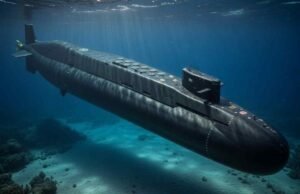
1️⃣ Strengthening the Nuclear Triad
India’s nuclear triad consists of:-
- Land-based ballistic missiles
- Air-delivered nuclear weapons
- Sea-based nuclear deterrent
With INS Aridhaman, the sea-based component gains depth and redundancy. A single SSBN provides symbolic deterrence; multiple SSBNs provide operational credibility.
2️⃣ Expanding Operational Reach
The extended range of K-4 SLBMs allows India to strike strategic targets without exposing submarines to adversarial anti-submarine warfare networks. This reduces vulnerability while enhancing survivability.
3️⃣ Regional Signalling
In an increasingly contested Indian Ocean, where both China and Pakistan are expanding naval capabilities, a credible SSBN fleet signals India’s long-term maritime intent.
China’s expanding SSBN fleet and Pakistan’s pursuit of sea-based deterrence through conventional submarines underscore a regional undersea competition. INS Aridhaman positions India as a stable but capable nuclear power with assured retaliation capability.
Who Benefits?
- India’s Strategic Command Authority: Gains greater flexibility and survivability.
- Indian Navy: Moves closer to maintaining continuous at-sea deterrence (CASD).
- India’s geopolitical standing: Strengthens deterrence credibility in the Indo-Pacific.
Unlike aircraft carriers that project power visibly, SSBNs project power silently — through uncertainty. That uncertainty is the essence of deterrence.
Risks and Limitations
Despite the milestone, challenges remain:
India must expand its SSBN fleet to maintain continuous patrol cycles.
Undersea domain awareness and anti-submarine warfare (ASW) capabilities must grow in parallel.
Technological secrecy and command-and-control protocols must remain robust to avoid strategic instability.
Moreover, submarine-based deterrence requires a secure communications architecture and strong civilian oversight — critical for a responsible nuclear power.
Long-Term Implications
INS Aridhaman signals that India’s strategic planning is maturing from symbolic deterrence to sustained operational capability.
In the long run:
- India may deploy larger S5-class SSBNs.
- The undersea domain will become central to Indo-Pacific competition.
- Sea-based deterrence will anchor India’s strategic autonomy amid great-power rivalry.
As power shifts accelerate across Asia, survivable deterrence ensures that India remains insulated from coercion while maintaining strategic restraint.
INS Aridhaman is not merely another submarine — it is a statement that India’s deterrence posture is transitioning from developmental to deployable.
Follow our page @tejwas_ for daily updates.
Also see-