
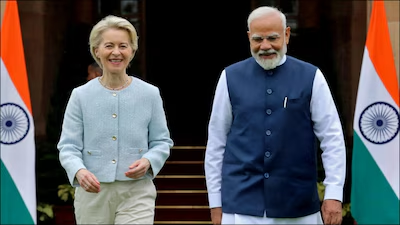
Trade relations between the European Union and India have officially entered a historic new chapter. As of late January 2026, both partners have reached a long-awaited milestone with the conclusion of a comprehensive Free Trade Agreement (FTA)—widely described as the “mother of all deals.”
This landmark agreement is more than just a trade pact; it is a strategic, economic, and geopolitical statement that reshapes EU–India cooperation for decades to come.
Current Trade Status (2025–2026)
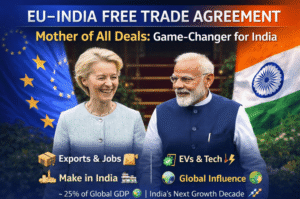
The EU remains India’s largest trading partner in goods. In the 2024–25 fiscal year, bilateral merchandise trade reached approximately $136.5 billion, slightly surpassing India’s trade with the United States.
- India’s Exports to EU: ~$75.9 billion (primarily refined fuels, smartphones, apparel, and pharmaceuticals).
- EU’s Exports to India: ~$60.7 billion (primarily high-end machinery, aircraft, and chemicals).
- Trade Surplus: India maintains a surplus of roughly $15 billion in goods and $9 billion in services.
The 2026 Free Trade Agreement (FTA)
After 18 years of intermittent negotiations, the conclusion of the FTA was announced on January 27, 2026, during the visit of European Commission President Ursula von der Leyen to New Delhi.
- Textiles & Apparel: India secured tariff elimination (down from 10–11%), allowing Indian exporters to compete on equal footing with Bangladesh and Vietnam.
- Automobiles: India agreed to a phased reduction of its 110% import duties on European cars over a 10–15 year period, primarily benefiting luxury brands like BMW, Mercedes, and Audi.
- Wines & Spirits: Drastic cuts to India’s >100% tariffs on European wines were a major EU win, though sensitive agricultural sectors remain largely protected.
- Professional Mobility: The deal includes easier work visas and “Talent Partnerships” for Indian ICT and medical professionals moving to the EU.
Despite the deal, friction remains in two specific areas:
- CBAM (Carbon Border Adjustment Mechanism): The EU’s “carbon tax” on imports (steel, aluminium) remains a point of contention, as it could add billions in costs for Indian exporters starting in 2026.
- Regulatory Alignment: Indian MSMEs (small businesses) struggle with the high costs of complying with new EU environmental and labour standards.
What India wants from the deal
For labour-intensive industries such as clothing, textiles, leather, jewellery, engineering products, and processed foods, India is looking for improved access to the EU market.
Following the EU’s 2023 withdrawal of concessions under its Generalized System of Preferences, several of these industries lost their tariff benefits. In a high-value consumer market, tariff reductions or eliminations under an FTA may help Indian exporters become competitive again.
Additionally, India is advocating for simpler access to IT and professional services, more efficient regulatory procedures for chemicals and pharmaceuticals, reduced double social security contributions, and easier mobility for skilled workers.
Sensitive industries like dairy and agriculture are still left out, which reflects New Delhi’s long-standing efforts to defend indigenous farmers.
What the EU stands to gain
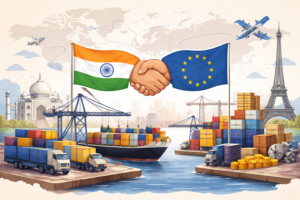
Deeper access to one of the fastest-growing major economies in the world is made possible for the EU.
Import tariffs on European wines and spirits, which presently range between 150 and 200%, are likely to be scaled down, with simpler certification procedures. Lower tariffs and reduced regulatory hurdles are also expected to benefit high-end automobiles, machinery, chemicals, medical devices, and electrical equipment.
Beyond products, Brussels is looking for greater investment protections as well as more precise regulations on services, procurement, intellectual property, labour, and environmental standards. The pact is also expected to increase European investment in India’s industry, clean energy, and digital infrastructure.
What happens after the announcement
Even if leaders announce the conclusion of negotiations this week, the deal will not take effect immediately. It must be legally finalised and ratified by the European Parliament, a process that could take at least a year and may face political hurdles.
Investment protection and geographical indications are being negotiated separately, narrowing the FTA’s initial focus to goods, services and trade rules.