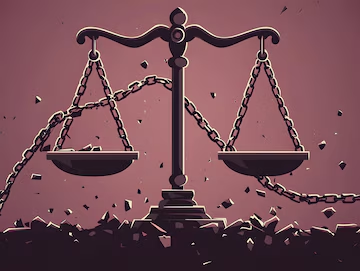


For much of the 20th century, America’s strength abroad was reinforced by unity at home. Today, that foundation is visibly fractured. Deep political polarization within the United States is no longer just a domestic issue—it has become a geopolitical vulnerability, shaping how allies trust Washington and how rivals challenge it.
In an era of great-power competition, internal division is emerging as one of America’s biggest strategic weaknesses.
🧠 Polarization and Governance Paralysis
The US political landscape is increasingly divided along ideological, cultural, and institutional lines. Policy-making has become gridlocked, with frequent government shutdown threats, budget standoffs, and legislative deadlock.
This paralysis affects long-term strategy. Foreign policy requires continuity, yet deep polarization makes sustained commitments difficult, especially when each election cycle threatens a complete reversal of priorities.
🌍 Foreign Policy Inconsistency
One of the most damaging consequences of polarization is inconsistency. International agreements, alliances, and commitments often shift depending on which party holds power.
For allies, this creates uncertainty. For adversaries, it opens opportunities to wait out policies they oppose, confident that domestic divisions may eventually undo them.
⚔️ How Rivals Exploit US Divisions
Strategic competitors closely monitor America’s internal fractures. Information warfare, cyber influence operations, and propaganda campaigns are designed to amplify divisions rather than create them.
By undermining trust in institutions and democratic processes, rivals weaken America’s ability to project moral authority and leadership abroad.
🛡️ Impact on Alliances

Alliances thrive on reliability. When US domestic politics dominate foreign policy decisions, allies are forced to hedge their bets—diversifying partnerships and reducing overdependence on Washington.
This does not mean abandonment of the US, but it does dilute American influence over time.
🇺🇸 Power Still Remains—But at a Cost
Despite internal divisions, the US remains a global heavyweight. Its military capabilities, innovation ecosystem, and alliance network are unmatched. However, polarization increases the cost of leadership and slows decision-making at critical moments.
Strength without cohesion limits strategic effectiveness.
🔮 The Strategic Implications Ahead
In the long run, the greatest threat to American global power may not come from external rivals, but from unresolved internal fractures. Unity enables strategy; division invites challenge.
If the US can rebuild internal consensus, it can sustain global leadership. If not, it risks becoming a powerful yet unpredictable actor in an increasingly competitive world.
In geopolitics, credibility begins at home—and the world is watching.