
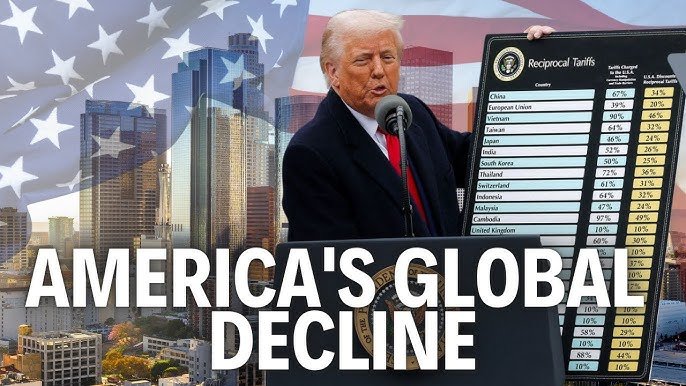
For decades after the Cold War, the United States stood as the undisputed global superpower. Its military reach, economic dominance, and political influence shaped the world order. Today, however, that dominance is increasingly questioned. From rising rivals to internal pressures, America’s global authority appears to be under strain.
The key question confronting geopolitics today is simple but profound: Is the US losing its superpower grip?
🌍 A World No Longer Unipolar
The post–Cold War unipolar moment is fading. China’s rise, along with the reassertion of powers like Russia and the growing influence of middle powers such as India, has pushed the world toward a multipolar order.
China’s economic scale, military modernization, and global infrastructure push through the Belt and Road Initiative challenge American influence, especially across Asia, Africa, and Latin America. Unlike the ideological Cold War, today’s competition is about markets, technology, and strategic access.
⚔️ Military Overstretch and Strategic Fatigue
The US maintains military presence in dozens of countries, but decades of prolonged conflicts have taken their toll. Wars in Iraq and Afghanistan cost trillions of dollars and eroded domestic support for overseas interventions.
Strategic withdrawals—most notably from Afghanistan—have fueled perceptions of declining resolve. While Washington frames these exits as recalibration, adversaries interpret them as signs of fatigue and hesitation.
💰 Economic Pressure at Home and Abroad
America’s economic power remains formidable, but cracks are visible. Rising debt, inflation pressures, and domestic political polarization limit Washington’s ability to project sustained power abroad.
At the same time, the weaponization of the US dollar through sanctions has encouraged rivals to explore alternatives, weakening long-term financial dominance. De-dollarization efforts, though gradual, signal a growing desire among nations to reduce dependence on the US-led system.
🧠 Credibility and Trust Deficit
One of America’s biggest challenges today is credibility. Frequent shifts in foreign policy priorities, driven by domestic politics, create uncertainty among allies. Commitments made by one administration are often reversed by the next.
This inconsistency complicates alliance management and gives rivals opportunities to expand influence by presenting themselves as more predictable partners.
🌐 Strategic Recalibration, Not Collapse
Despite these challenges, declaring the end of American power would be premature. The US still leads in military capabilities, innovation, higher education, and global alliances. Rather than decline, Washington appears to be undergoing a strategic recalibration—focusing on great power competition, technology dominance, and selective engagement.
The real test lies in whether the US can adapt to a world where it is first among equals, rather than the sole rule-setter.
🔮 The Future of American Power
The United States is not disappearing from global leadership—but its era of unquestioned dominance is over. In a multipolar world, influence will depend less on coercion and more on cooperation, credibility, and strategic consistency.
America’s superpower grip is loosening, but its ability to reshape its role will determine whether it remains a central pillar of global order—or just one power among many.