

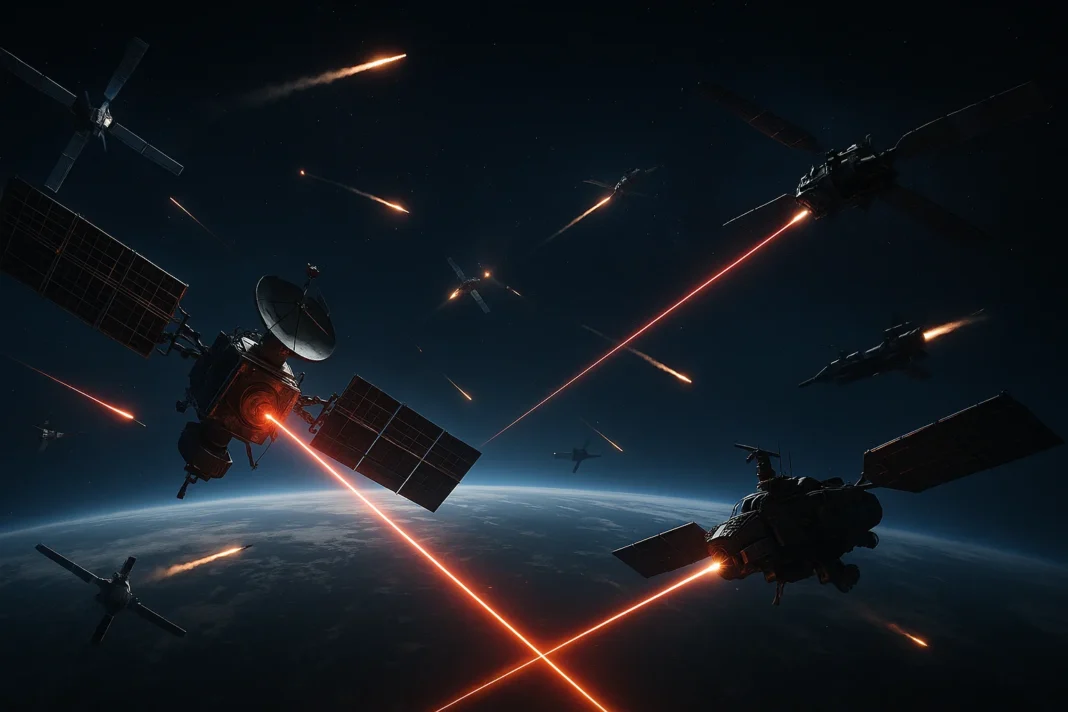
For decades, space was portrayed as a peaceful frontier for science and exploration. Today, it is quietly transforming into the next major battlefield. Satellites now power modern militaries, global economies, and everyday life—making space a critical domain in geopolitical competition. As major powers race to dominate orbit, the militarization of space could define the future of global conflict.
🌌 Why Space Has Become Strategically Critical
Modern warfare is impossible without space-based assets. Satellites enable:
-
Missile early-warning systems
-
GPS navigation for troops, ships, and aircraft
-
Secure military communications
-
Intelligence, surveillance, and reconnaissance (ISR)
Disabling an adversary’s satellites can blind its military without firing a single shot on Earth. This makes space control a decisive strategic advantage.
🚀 The Major Players in Space Militarization
The world’s leading powers are rapidly expanding their space warfare capabilities:
-
United States: Established the US Space Force to protect satellites and ensure space superiority.
-
China: Conducted advanced anti-satellite (ASAT) tests and integrated space dominance into its military doctrine.
-
Russia: Developed electronic warfare and kinetic weapons capable of disabling satellites.
-
India: Demonstrated ASAT capability in 2019, signaling its entry into space security dynamics.
Space is no longer neutral—it is contested.
⚔️ Anti-Satellite Weapons: The New Arms Race

ASAT weapons include:
-
Kinetic missiles that physically destroy satellites
-
Directed-energy weapons like lasers
-
Cyber attacks that hijack or disable satellite systems
-
Electronic jamming to block signals
The danger lies in debris creation. Destroyed satellites generate thousands of fragments, threatening other spacecraft and potentially triggering a cascading “Kessler Syndrome” that could make entire orbits unusable.
🌍 Civilian Life at Risk
The militarization of space is not just a military concern. Civilian infrastructure relies heavily on satellites for:
-
Internet and mobile networks
-
Banking and financial transactions
-
Weather forecasting and disaster response
-
Aviation and maritime navigation
A space conflict could cripple economies, disrupt daily life, and create global chaos without a single bomb falling on cities.
🇮🇳 India’s Strategic Position

India is increasingly aware of space vulnerabilities. With growing dependence on satellites for defense, navigation, and digital services, New Delhi has emphasized:
-
Space situational awareness
-
Indigenous satellite protection capabilities
-
Strategic deterrence without weaponizing space aggressively
India’s approach reflects a balance between security preparedness and global responsibility.
📜 Weak Global Rules, Rising Risks
International space law, largely based on the 1967 Outer Space Treaty, prohibits weapons of mass destruction in space—but says little about conventional weapons or cyber attacks. This legal vacuum allows major powers to exploit gray zones, increasing the risk of miscalculation.
🔮 What the Future Holds
As Earth-based conflicts grow more technologically complex, space will become the first target, not the last. Future wars may begin with satellite disruptions that disable communication, navigation, and intelligence—paralyzing nations before traditional combat begins.
The battle for space dominance is already underway, and its outcome will shape global power in the decades to come. The next war may not start on land, sea, or air—but in orbit.