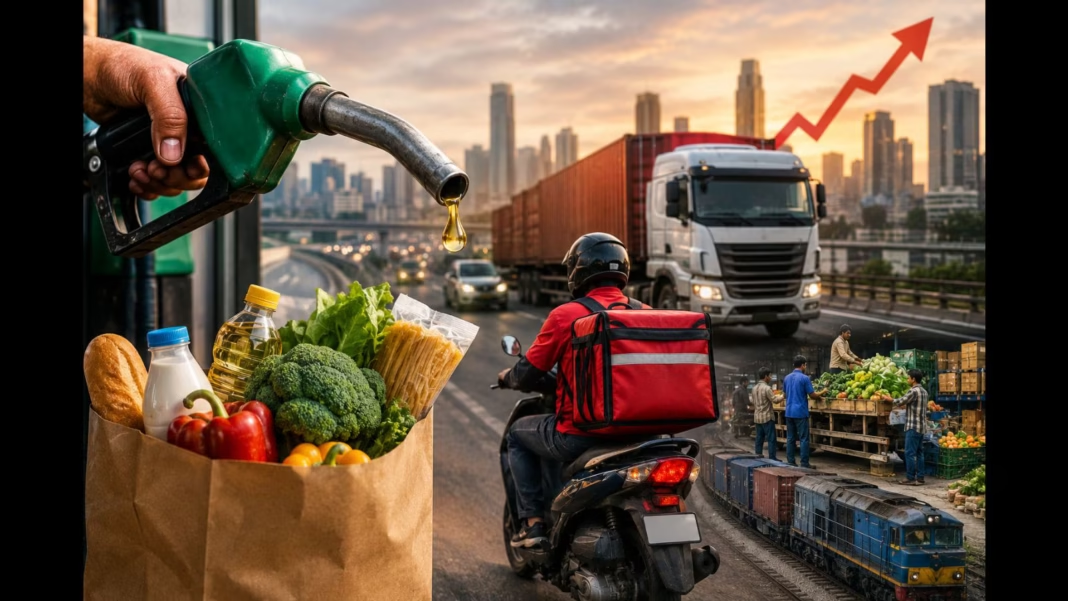

Why India’s rupee is falling has suddenly become one of the biggest economic discussions in the country as the Indian currency continues to hit record lows against the US dollar. Over the past few weeks, the rupee has weakened sharply amid rising geopolitical tensions, expensive crude oil, foreign investor outflows, and a globally strengthening dollar. The decline has not only worried financial markets but has also raised an important question for ordinary citizens: what does a weaker rupee actually mean for everyday life?
As of May 2026, the Indian rupee has slipped beyond historic levels against the US dollar, becoming one of Asia’s weakest-performing currencies this year. Reports suggest the rupee recently crossed the ₹96 per dollar mark, driven largely by rising oil prices and global economic uncertainty linked to tensions in West Asia.
For economists and policymakers, currency fluctuations are part of a broader global financial cycle. But for ordinary citizens, the consequences are far more direct. A falling rupee eventually affects fuel prices, imported goods, inflation, education abroad, travel expenses, and even household budgets.
The issue is not just about currency exchange rates. It is about how global events quietly reshape domestic economic realities.
What Does a Falling Rupee Actually Mean?
A falling rupee simply means that the Indian currency is losing value compared to another currency, most importantly the US dollar.
For example, if one dollar earlier cost ₹82 and now costs ₹96, it means the rupee has weakened significantly. Indians now need more rupees to purchase the same amount of dollars.
This matters because international trade largely happens in dollars. India imports crude oil, electronic goods, machinery, semiconductors, and several essential commodities from global markets using US currency. When the rupee weakens, buying these imports becomes more expensive.
The result is simple:
Higher import costs eventually increase prices inside the country.
Why the Rupee Is Falling in 2026
The current decline of the rupee is not caused by one single factor. Instead, it is the result of several global and domestic pressures coming together simultaneously.
One of the biggest reasons is the sharp rise in global crude oil prices. India imports nearly 85 percent of its crude oil requirements, making it heavily dependent on international energy markets. As oil prices rise, India needs more dollars to pay for imports, increasing pressure on the rupee.
The ongoing geopolitical tensions involving Iran and instability in the Middle East have significantly pushed oil prices upward. Brent crude prices recently crossed major levels, increasing concerns over India’s import bill and trade deficit.
Another major factor is the strengthening US dollar itself. Global investors currently view the dollar as a safer asset because of higher US interest rates and global uncertainty. Whenever fear rises in international markets, investors usually move money into dollar-based assets.
This creates greater demand for the dollar globally while weakening emerging market currencies like the Indian rupee.
Foreign investor outflows are also adding pressure. In recent months, several foreign institutional investors have pulled money out of Indian equity and bond markets. When investors move money out of India, they convert rupees into dollars, increasing dollar demand and weakening the rupee further.
At the same time, rising US bond yields have made American financial markets more attractive for global investors compared to emerging economies. This shift in global capital flows has intensified currency pressure across Asia, including India.
Why Oil Prices Matter So Much for India

Energy lies at the center of India’s currency problem.
India is one of the world’s largest importers of crude oil, and almost all of those transactions happen in dollars. Whenever oil becomes expensive globally, India requires significantly more dollars to purchase the same quantity of crude.
This widens India’s trade deficit, which refers to the gap between imports and exports.
A larger trade deficit means more dollars leave the country than enter it. That imbalance weakens the rupee over time.
The current geopolitical situation in West Asia has therefore become extremely important for India’s economy. Even though the conflict may appear geographically distant, its economic effects travel rapidly through energy prices, financial markets, and currency movements.
In a globalized economy, geopolitical instability in one region can directly affect household expenses thousands of kilometers away.
How a Weak Rupee Affects Ordinary Citizens
For most people, currency exchange rates feel distant and technical until they begin affecting daily expenses.
The first major impact usually appears through inflation.
When imports become expensive, companies pass those higher costs to consumers. Fuel prices rise, transportation becomes costlier, and the prices of goods dependent on imported raw materials gradually increase.
Electronics such as smartphones, laptops, cameras, gaming consoles, and imported appliances may become more expensive because many components are purchased internationally in dollars.
Travel abroad also becomes significantly costlier. Indians studying overseas, planning international vacations, or paying foreign university fees will need more rupees to purchase dollars. Even subscription services and digital platforms linked to international payments can become more expensive over time.
Businesses dependent on imports also face pressure. Industries relying on imported machinery, chemicals, semiconductors, or industrial materials may experience rising operational costs. Eventually, this can influence product pricing and business profitability.
The psychological impact matters too.
A weakening currency often creates public anxiety because it is viewed as a sign of economic weakness, even though currency movements are influenced by global cycles and not just domestic conditions.
Does a Falling Rupee Mean India’s Economy Is Weak?
Not necessarily.
Currency depreciation does not automatically mean an economy is collapsing. In fact, many strong economies experience periods of currency weakness due to global financial conditions.
The current pressure on the rupee is linked heavily to external factors such as:
- global oil prices
- geopolitical tensions
- US interest rates
- investor behavior
- international capital flows
However, a continuously weakening currency can become problematic if inflation rises sharply or if import costs remain elevated for a prolonged period.
Economists often distinguish between short-term currency volatility and long-term structural economic strength. India still remains one of the world’s fastest-growing major economies, but global instability is currently creating financial pressure across emerging markets.
Are There Any Benefits to a Weak Rupee?
Interestingly, a weaker rupee can benefit certain sectors.
Indian exporters often gain when the rupee weakens because their goods become cheaper for international buyers. Industries such as IT services, pharmaceuticals, textiles, and export-driven manufacturing may see increased competitiveness globally.
For example, Indian IT companies earning revenue in dollars can benefit when those earnings convert into more rupees domestically.
This is one reason why currency depreciation is not viewed entirely negatively by economists.
The challenge lies in balancing export competitiveness with inflation control.
If the rupee falls too sharply, the negative impact on imports and inflation can outweigh the export advantages.
What Is the RBI Doing?
The Reserve Bank of India has been actively monitoring the situation and intervening periodically to reduce excessive volatility in the currency market.
The RBI usually does not try to completely “fix” the rupee at a particular level. Instead, it focuses on preventing sudden panic-driven movements that could destabilize markets.
Reports indicate that the RBI has already intervened multiple times in recent weeks to slow the rupee’s decline.
The central bank may also use monetary tools, forex reserves, and policy adjustments to manage inflation and stabilize investor confidence.
However, no central bank can fully isolate its currency from large global economic forces, especially during periods of geopolitical uncertainty.
Why This Matters Beyond Economics
The falling rupee is ultimately a reminder of how interconnected the modern world has become.
A conflict in West Asia affects oil prices.
Oil prices affect India’s import bill.
Import costs affect the rupee.
The rupee affects inflation.
Inflation affects ordinary households.
What appears like a technical financial issue is actually deeply connected to everyday life.
In many ways, currency movements reflect global confidence, geopolitical stability, energy dependence, and investor psychology all at once.
That is why discussions around the rupee are no longer limited to economists or stock market analysts. They have become part of a much broader conversation about economic resilience, global uncertainty, and how international events shape domestic realities.
Conclusion
The recent fall of the Indian rupee is not the result of a single domestic failure but rather the outcome of multiple global pressures converging at the same time. Rising oil prices, geopolitical tensions, foreign investor outflows, and a stronger US dollar have collectively pushed the rupee toward record lows in 2026.
For ordinary citizens, the consequences may gradually appear through inflation, higher fuel costs, expensive imports, and rising international expenses. At the same time, some export-oriented sectors could benefit from a weaker currency.
The larger concern, however, lies in how long these pressures continue and whether global conditions stabilize in the coming months.
Currency fluctuations are a normal part of the global economy, but their effects are never limited to financial markets alone. Eventually, they influence how people spend, save, travel, invest, and live.
Do you think the falling rupee is a temporary global reaction or a deeper economic concern for India? Share your thoughts on how rising inflation and currency pressure are affecting everyday life.
Follow us on instagram @thetejwas to get daily updates.
Also see-